Without seeming to downplay presidential successions, the most memorable was in 2002 when the late President Daniel Moi was exiting from power.
Though debatable, the 2002 polls were largely free and fair. No notable loser petitioned the court to protest the outcome of that presidential election.
Back then, the country was wriggling out of a long period of single party system.
Although by 1992 multiparty system had been achieved, the professor of politics had outwitted pro-democracy leaders with divide and rule tactics to remain in power.
In 2002, when Moi had to relinquish power as per the constitution, it was the first time presidential project appeared in the Kenyan political lexicon.
Clever Moi had single-handedly selected Uhuru Kenyatta as his preferred successor, setting a number of events in motion that culminated in prove that Moi was an erstwhile political genius.
Moi had surveyed the political scene and realised that the contest for the presidency was overcrowded and calculated that by creating project Uhuru from Mt Kenya, two things were likely to happen.
Firstly, the egoistic leaders who were interested in succeeding him would split the vote and afford Uhuru an easier win and secondly, if the opposition united, there was likelihood they would front a leader from Mt Kenya as their flag bearer in order to beat Moi in his own game.
The second plan worked and Moi’s Uhuru project was ‘defeated’ after the opposition fronted Mwai Kibaki as a candidate.
Back then, the 50+1 vote to win the presidency was not a requirement in presidential election.
Moi endured a moment of humiliation at a ceremony to hand over the sword of power at Uhuru Park in Nairobi and thereafter proceeded to his home in Kabarak, Nakuru County all smiles.
The great political Giraffe had executed one of his most difficult task in politics- ensuring he left power where he wanted it to be.
Not only did Moi ensure Kenya was in good hands but he also invested wisely by putting a future president in the political vault- his project.
The next presidential project happened during the Kibaki succession.
For the first time since the dawn of multiparty and constitutional democracy in Kenya, the outcome of a presidential election was seriously contested in court.
Having kept himself aloof from who was to succeed him, President Mwai Kibaki was rumoured to favour Uhuru Kenyatta and the opposition ganged up to once again brand Uhuru as a State project in a bid to turn voters against his presidential bid.
Kibaki’s hand in the 2013 succession was discernible in the conduct of state officials and the opposition that had chosen, Raila Amolo Odinga as its flag bearer smelt power.
The opposition quickly reintroduced the ‘Mt Kenya Mafia’ and the 41 versus 2 (tribes) fear politics, thus converting the 2013 into the most divisive and controversial presidential election under the new democratic and constitutional order.
‘Kibaki’s project Uhuru’ won the contest and the country held its breath as the defeated opposition protested but failed to convince the Supreme Court to nullify one of the most disorganized presidential election ever to be administered by the IEBC.
This year, the presidential succession project has reared its ugly head with full force.
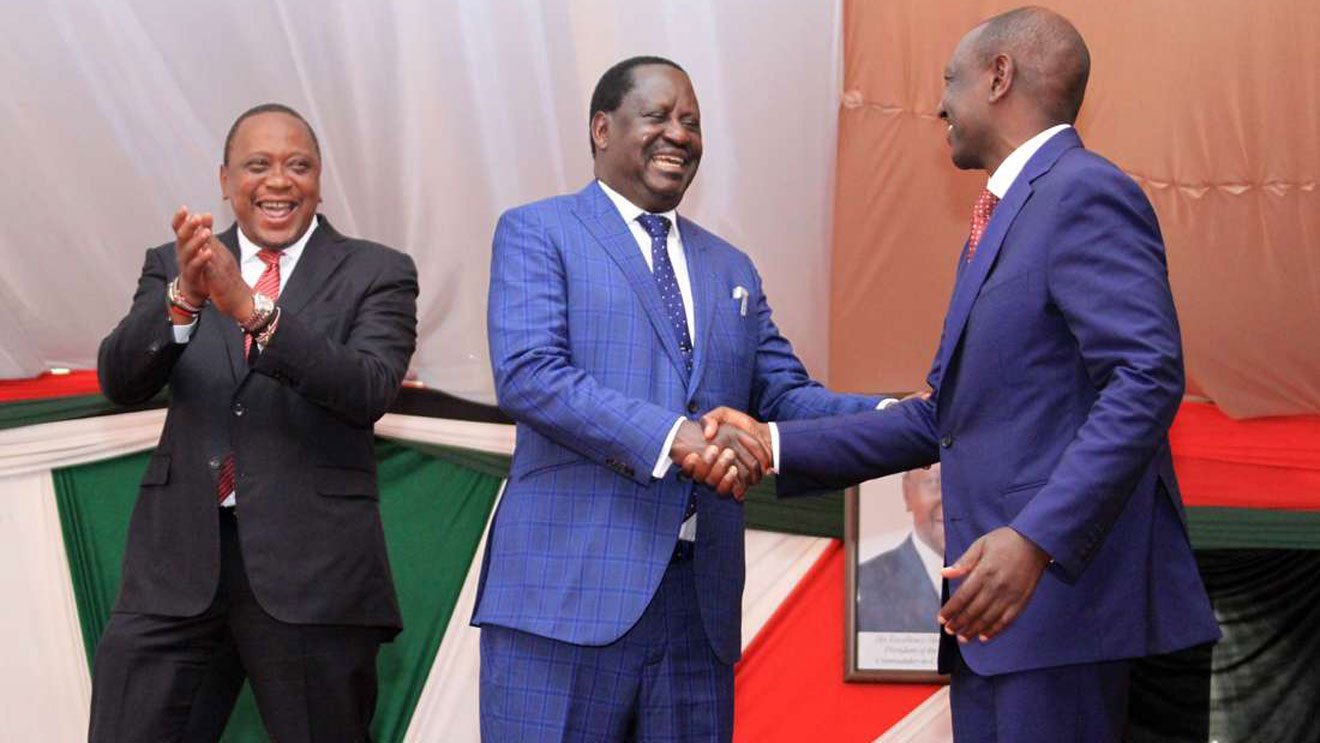
Unlike in the last two presidential successions, whereby candidates were from Mt Kenya region, for the first time the leader who is being branded a State project has been a long serving opposition firebrand and the most aggrieved presidential contender to ever walk the political scene in this country.
Raila Amolo Odinga could be described simply as an enigma of Kenyan politics, who has twice come close to winning the presidency.
Is Raila Amolo Odinga a proof that there can never be a presidential election without a state project in Kenya?
Perhaps to answer this question, it is important to ask it in another way? Is there a country in the world, whereby an outgoing regime has no preferred successor?
In my view, this can only happen in utopianism. Regimes must ensure that those who take over the reins of power are leaders who subscribe to their ideals.
After all there is the important matter of safety and security, that is, who would protect the interest of an outgoing regime.
Therefore, outgoing regimes have a bigger say and role in successions. For this reason, it is pointless for the opposition or citizens to expect anything less than the norm in successions.
For that matter, strategic opposition candidates and their parties shouldn’t waste time dwelling on the obvious because doing so, especially in countries whereby regimes always have their way, this could demoralize their supporters.
In this case, Kenya is no exception and the more the opposition mantra about project Raila, the more likelihood voters will identify with a ‘winner’.
Most people hate State projects in successions but the reality is that they are unavoidable.
If Uhuru had stuck with his deputy Dr William Ruto to succeed him, the latter would be a State project. True or false?
What is the point here?
Is it possible for a popular oppositionist who has a strong tradition national support to lose a presidential election in Africa because he or she has become a State project?
If this happens, Kenya will make history by having a State presidential project of the calibre of Raila Amolo Odinga defeated at the ballot.
By the way no State presidential project has been defeated so far. Who knows, this could be the first time it happens in Kenya.
But I highly doubt it.
Kaunda wa Muchunku
Do you have an interesting commentary you want published on thepresspoint.com, share with us via thepresspoint07@gmail.com