By Mourice Seretta
Charles Mukwana, a person living with disability (PWD), lost his lucrative job as a sales executive in a leading Insurance firm in Kenya at the height of Covid-19 pandemic but that setback did not deter him from pursuing other ventures to make ends meet.
When the pandemic hit Kenya and the government-imposed measures to curb the spread of the disease and many companies asked their employees to work from home, Mukwana’s Insurance firm offloaded some of its employees and he was not spared the axe, with a promise of getting recalled but that never happened.
Instead of hitting the streets like many of his peers to beg, the father of four living in Nairobi, Kenya decided to use his small savings to start a small venture of selling snacks in town so as to enable him fend for his family and settle other bills.
The business sees him wake up in the wee hours of the morning, prepare the snacks from outside of his house helped by his family, then later ferries the snacks to town where he has a small shop from where he operates.
The snacks cost between Sh10 and Sh20 and are on high demand as majority of Nairobians prefer them to heavy meals due to hard economic times, he says.
Mukwana discloses that the business has enabled him pay school fees for his children, pay rent, buy food and settle other family needs.
“I was earning a decent salary that enabled me sort my family’s bills, move around and spare some for miscellaneous. But that has not been the case (since Covid-19 struck). Life has not been easy as I have been struggling to make ends meet,” Mr Mukhwana says.
“I am optimistic because my business is up and running and it is helping a lot including helping sort out some bills for my friends.”
He adds that the business has also seen him help several people with special needs in Central Business District where he has set his business and others from the locality he lives in.

These, he says, are some of the friends he made when he was working and who he occasionally used to help, a trait he says he is not willing to drop despite the challenges he is faced with as some of them solely depend on begging in the streets.
“Some of these PWDs milling around me here, we became friends when I was working in my former white-collar job. I used to give them some cash to sustain their lives and to them it was a norm. The small I get from here I share with them. Some of them as you can see are completely immobile and cannot do anything,’ Mr Mukwana reveals while beckoning to a man living with a disability to get some snacks for kids playing-by.
He says his motivation to work hard is driven by the desire to help other members of special groups who are unable to fend for themselves.
His spouse, Mary Mukwana, says even after he was laid off, the husband remained committed to providing for the family while assisting the needy.
“He (husband) never lost hope despite losing his job and the promise of being reinstated not honoured. He has always fought for and worked hard to provide for the family,” Mary says of her husband.
She says his hard work has not only been encouraging neighbors and friends but also other PWDs most of whom have started emulating him.
“You are not the only ones to come to witness (what he is doing). The community around here is equally amazed by his hard work. They always come here for his snacks before he lives for town. They also desire to work hard like him,” she said during a recent interview.
Mukwana says he intends to expand his business so as to employ some of his friends going through similar challenges like him so as they also eke a living.
“I will continue working harder to ensure my business grows in leaps and bounds so that I can accommodate a few so that they can fend for themselves. I will also liaise with relevant authorities like the Association for the Physically Disabled of Kenya for assistance,” he says with a smile.
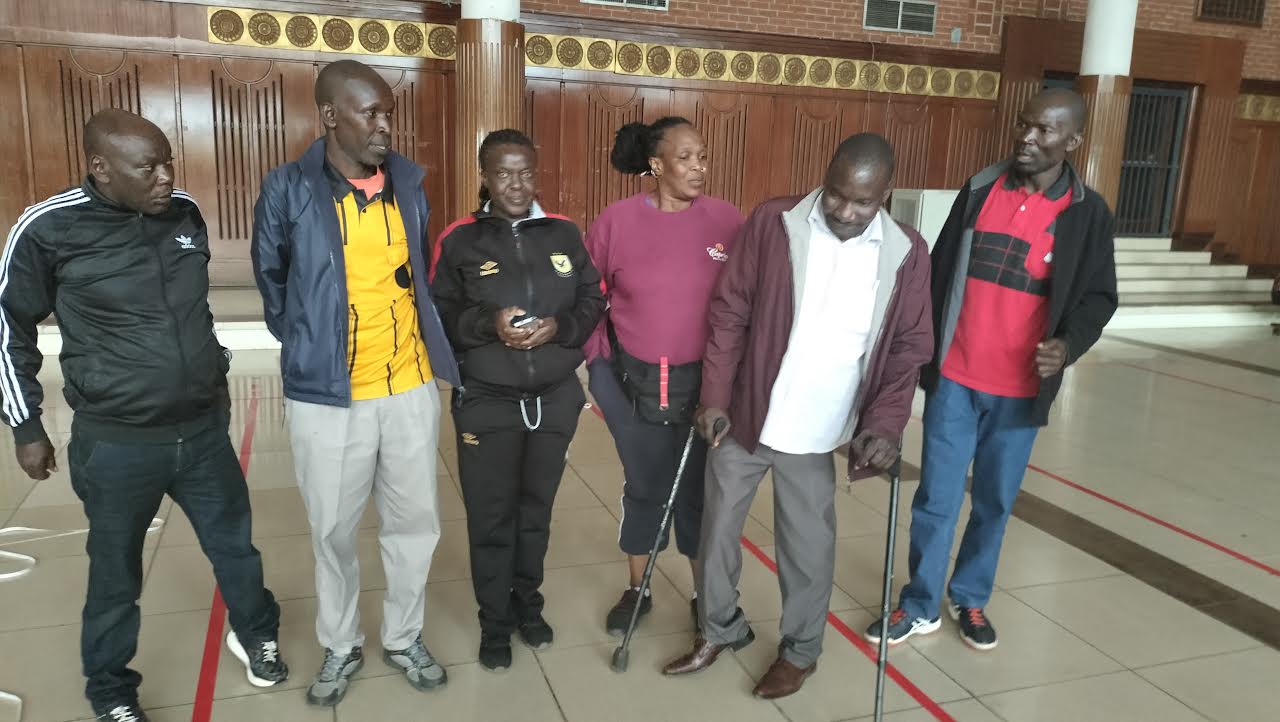
Mukwana, who has since also joined the Kenya Para-Volley team, says the government should support sporting activities for PWDs to enable them hone their skills and for economic empowerment.
The Association for the Physically Disabled of Kenya (APDK) says the pandemic forced them to close their offices for a few days and direct their staff to work from home like it happened to Mukwana.

APDK’s Nairobi Branch Manager Ms Christine Muteti said they distributed protective gears like masks, hand sanitizers to their members and also put up hand washing points and ensured its staff were vaccinated in efforts to stem spread of the virus.
Failure by the government to disburse funds to the Association, she said, made it challenging for them to mitigate the adverse effects of the pandemic on their members.
“We still feel the impact. Funding stopped after some of the sponsors withdrew their support. But we are grateful that we did not lose anyone to Covid-19 related illnesses but only two of our members were infected,’ Ms Muteti said.
Her remarks were echoed by the Association’s Programs Officer Benson Agesa who said the State was also slow in disseminating Covid-19 information to the public and only focused on reporting numbers of those infected and who died from the disease.
Apart from losing their jobs, Persons with disabilities have also become a heightened target for discrimination not only because of their disability but because of a recent ’unspoken myth’ that PWDs are somehow more likely to have the virus.
There is a case in which people refused to board a matatu because an individual with albinism was in the same vehicle. This was done in the guise of social distancing.
The government is yet to roll out mechanisms to get personal protective equipment to PWD‘s for free. People with visual disability need PPE even more than average Kenyan, for example, hand sanitisers and latex gloves as they rely heavily on using their hands for tactile feedback.
However, using gloves heavily distorts the detail of feeling different surfaces for the blind and visually impaired. The masks being sold and distributed do not take into consideration the deaf community who use lip-reading as a means of communication.
Statistically, the United Nations states that 15% of the populations or 1 billion people with disabilities in the world are among the hardest hit by COVID-19.
UN indicates that 80 percent of PWDs live in developing countries. An estimated 46 percent of people aged 60 years and above have different forms of disabilities.
Several reports show that majority of the PWDs did not receive any assistance from any formal sources with only a few benefiting from existing social protection programs and COVID-19-specific assistance.
This publication was produced with the financial support of the European Union. Its contents are the sole responsibility of Mourice Seretta and do not necessarily reflect the views of the European Union.